
Cell and Cell Organelle
About cell and cell organelle
Cells are complex, and their constituents serve a variety of tasks in an organism. Similar to constructing bricks, they come in a variety of sizes and shapes. Living organisms are made up of cells of different shapes and sizes.
In addition, it gives structure to the body and converts nutrients into energy.
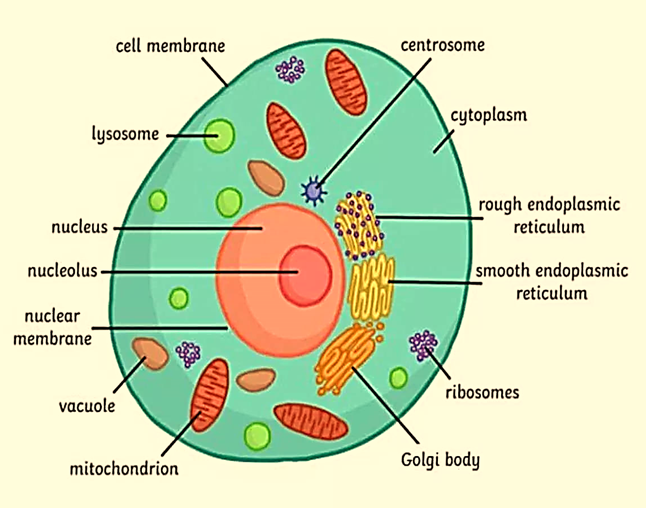
Cells and thus organisms can be categorized as eukaryotic or prokaryotic depending on whether they include or lack a membrane-bound nucleus and other organelles.
Prokaryotic Cells
Prokaryotic cells are those without a membrane-bound nucleus. Bacteria, blue-green algae, mycoplasma, and PPLO (Pleuro Pneumonia Like Organisms) are examples of prokaryotic cells. No distinct nucleus is present. Lysosomes, chloroplasts, Golgi bodies, and mitochondria are not present.
Eukaryotic Cells
- Eukaryotic cells have a well-organized nucleus surrounded by a nuclear envelope. The genetic material in their bodies is organized into chromosomes.
- Not every eukaryotic cell is the same. They can reproduce asexually or sexually.
![Difference between Eukaryotes and Prokaryotes [with Table] - Teachoo](https://samyakias.com/assets/uploads/gsstudy/img_20260706_180736_6ba10e3f7e_2.png)
Cell Organelles
A cell organelle is a subcellular structure that, like an organ in the body, has one or more specific tasks to carry out within the cell. The nucleus, mitochondria, and ribosomes are a few of the more significant cell organelles.
Cell Membrane
- The plasma membrane is another name for the cell membrane.
- The cell’s plasma membrane is its outermost layer, separating its interior from the outside world.
Cell Wall
- The cell wall is a non-living hard structure that produces an exterior coating for the plasma membrane of fungi and plants. The cell wall not only gives the cell structure and safeguards it from mechanical harm and infection, but it also facilitates cell-to-cell communication and acts as a barrier to unwanted macromolecules.
- The cell wall is absent in animals.
Cytoplasm
- It is the jelly-like material situated between the nucleus and the cell membrane. The liquid substance that makes up the plasma membrane is called cytoplasm.
- Several specialized cell organelles are also present.
Nucleus
Every eukaryotic cell has a double-membraned organelle called the nucleus. It is the largest organelle and serves as the command center for cellular operations as well as the Genetic repository for the cell.
Mitochondria
- Mitochondria are the sites of aerobic respiration.
- They are referred to as the “powerhouses” of the cell since they generate cellular energy in the form of ATP.
- The mitochondrion is a double membrane-bound structure with the outside and inner membranes distinctively partitioning its lumen into two aqueous compartments, namely the outer and inner compartments.
The Endoplasmic Reticulum
The endoplasmic reticulum (ER) is a network or reticulum of minute tubular structures dispersed throughout the cytoplasm.
Ribosomes
- Ribosomes are significant cytoplasmic organelles that are not membrane-bound and are found in close proximity to the endoplasmic reticulum. Either the endoplasmic reticulum encloses ribosomes or they are freely dispersed throughout the cytoplasm of the cell.
- They are made of proteins and ribonucleic acid (RNA)
Lysosomes
They are membrane-bound vesicular structures that are the result of the Golgi apparatus’s packaging process. also known as “suicidal bags”.
Vacuoles
- The membrane-bound area in the cytoplasm is known as the vacuole.
- The vacuoles in plant cells are larger than those in animal cells.
Plastids
Every plant cell, including euglenoids, contains plastids. They may be seen clearly under a microscope due to their size. They carry particular pigments, which give the plants particular colors. Chloroplasts, chromoplasts, and leucoplasts are three different types of plastids.
Cilia and Flagella
Cilia and flagella are outgrowths of the cell membrane that resemble hair
Centrosome and Centrioles
The centrosome organelle is made up of two centrioles, which are mutually perpendicular structures.
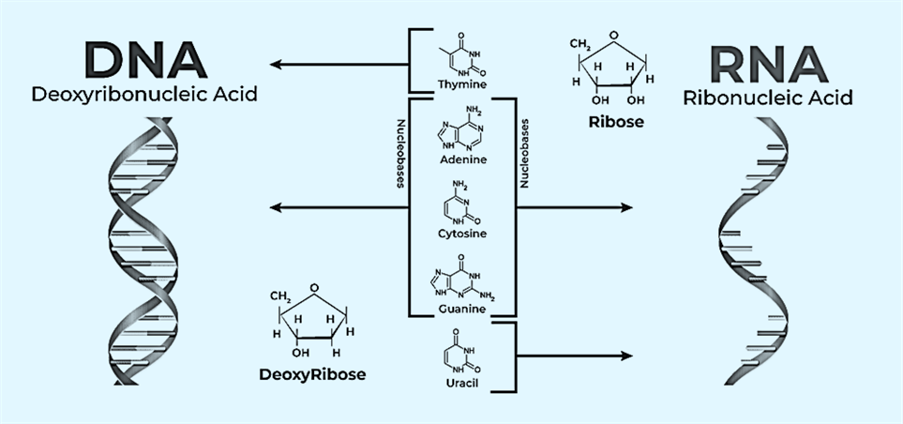
DNA and RNA
|
Aspect |
DNA |
RNA |
|
1. Composition |
Deoxyribonucleic acid |
Ribonucleic acid |
|
2. Location |
Found inside the nucleus and some cell organelles; also in mitochondria and plant cells |
Mostly found in the cytoplasm, with limited presence inside the nucleus |
|
3. Structure |
Double-stranded molecule with long chains of nucleotides |
Single-stranded helix with shorter chains of nucleotides |
|
4. Function |
Stores and transfers genetic information for cell and organism development |
Transfers genetic code from nucleus to ribosomes for protein synthesis |
|
5. Composition of Strands |
Two nucleotide strands with stable deoxyribose sugar and four nitrogen bases |
Single strand with less stable ribose sugar and four nitrogen bases |
|
6. Base Pairing |
Adenine pairs with Thymine (A-T); Cytosine pairs with Guanine (C-G) |
Adenine pairs with Uracil (A-U); Cytosine pairs with Guanine (C-G) |
|
7. Replication |
Self-replicating |
Synthesized from DNA when needed |
|
8. Helix Geometry |
Formed as B-helix; susceptible to damage by UV rays |
Formed as A-helix; more resistant to UV damage |
|
9. Length |
Long polymer chain |
Shorter polymer chain |
|
10. Helix Type |
Regular spirally twisted helix |
Secondary or pseudo helix |
|
11. Structure Form |
Chromosomes or chromatin fibers |
Ribosomes or association with ribosomes |
|
12. Quantity |
Fixed quantity for a cell |
Variable quantity for a cell |
|
13. Types |
Intra-nuclear and extra-nuclear |
Messenger RNA (mRNA), Transfer RNA (tRNA), Ribosomal RNA (rRNA) |
|
14. Lifespan |
Long lifespan |
Short lifespan (variable) |
DNA fingerprinting
- DNA fingerprinting is a technique used to analyze the genetic makeup of living organisms.
- It involves identifying and comparing specific regions of DNA, often referred to as satellite DNA regions, within an individual's genome.
- These satellite DNA regions contain repetitive sequences of nucleotides that vary in length and are unique to each individual. By analyzing the variations in these regions, scientists can create a unique genetic profile or "fingerprint" for an individual.
- This fingerprint can be used for various purposes, including forensic identification, paternity testing, and genetic research. DNA fingerprinting has revolutionized fields such as forensic science and has become a powerful tool for identifying individuals and studying genetic diversity.
Important concepts of Genetics
- Genetic Drift: The random fluctuation in allele frequencies within a population over generations due to chance events. It is more pronounced in smaller populations and can lead to the loss of genetic diversity.
- Natural Selection: The process by which certain heritable traits confer a reproductive advantage, leading to their increased frequency in a population over successive generations. It is a key mechanism driving evolution by means of adaptation to environmental pressures.
- Mutation: The process of changes in the DNA sequence, resulting in new alleles or genetic variations. Mutations are the ultimate source of genetic diversity and can be caused by various factors such as radiation, chemicals, or errors in DNA replication.
- Founder Effect: A type of genetic drift that occurs when a small group of individuals migrates and establishes a new population with a limited gene pool, leading to differences in allele frequencies compared to the original population.
- Bottleneck Effect: Another type of genetic drift that occurs when a population undergoes a dramatic reduction in size, resulting in a loss of genetic diversity due to the random sampling of alleles from the surviving individuals.
- Hardy-Weinberg Equilibrium: A mathematical model describing the relationship between allele and genotype frequencies in a population that is not evolving. It provides a baseline for studying genetic processes such as mutation, selection, and drift.
- Heterozygote Advantage: A phenomenon where individuals heterozygous for a particular gene have a higher fitness compared to homozygotes, leading to the maintenance of genetic variation within a population.
- Genetic Linkage: The tendency for alleles of different genes located close to each other on the same chromosome to be inherited together, which can affect the outcome of genetic crosses and contribute to genetic diversity.
- Molecular Clock: The concept that evolutionary changes occur at a constant rate over time, allowing for the estimation of divergence times between species based on the accumulation of genetic mutations.
Recombinant DNA Technology
- Recombinant DNA technology involves using enzymes and various laboratory techniques to manipulate and isolate DNA segments of interest.
- This method can be used to combine (or splice) DNA from different species or to create genes with new functions. The resulting copies are often referred to as recombinant DNA.
Such work typically involves propagating the recombinant DNA in a bacterial or yeast cell, whose cellular machinery copies the engineered DNA along with its own


.svg.png)


