
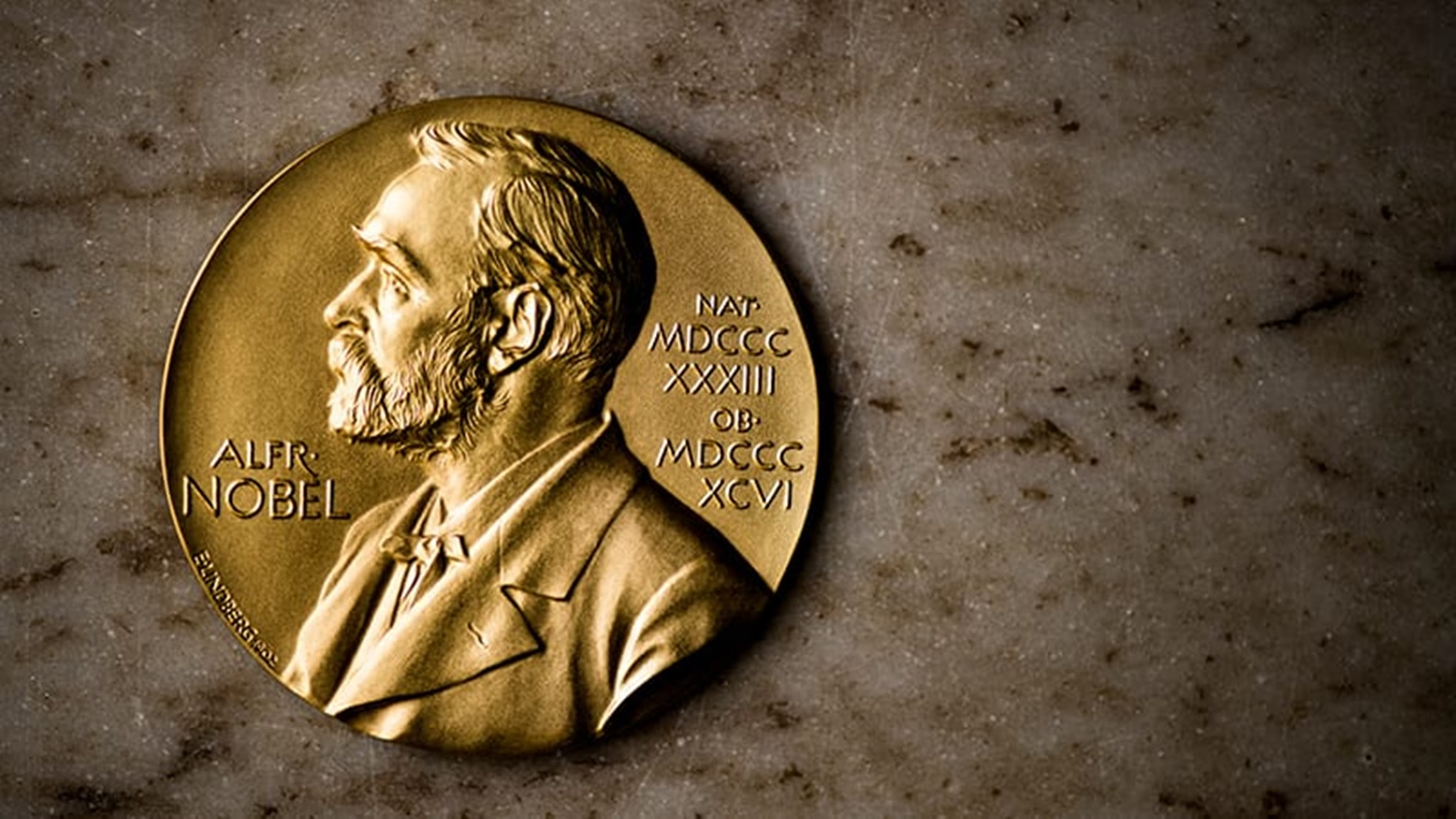
Total Laureates: 14 laureates were honoured across six categories — Physics, Chemistry, Physiology or Medicine, Literature, Peace, and Economic Sciences.
|
Nobel Prize (2025) |
Winner(s) |
About the Research / Contribution |
|
Chemistry
|
Susumu Kitagawa (Japan), Richard Robson (Australia), Omar M. Yaghi (USA) |
Awarded for the development of Metal-Organic Frameworks (MOFs)—highly porous crystalline materials made of metal nodes and organic linkers. MOFs have extremely large surface areas and tunable structures, enabling applications in carbon capture, gas storage, water harvesting, pollutant removal, catalysis, energy storage, and drug delivery. |
|
Physics
|
John Clarke (UK), Michel Devoret (France), John Martinis (USA) |
Recognised for demonstrating macroscopic quantum mechanical tunnelling and energy quantisation in electric circuits using Josephson junctions. Their work proved that quantum effects can occur in macroscopic systems and laid the foundation for quantum computing, quantum sensing, & quantum cryptography. |
|
Physiology or Medicine
|
Shimon Sakaguchi (Japan); Mary E. Brunkow and Fred Ramsdell (USA) |
Honoured for discoveries on peripheral immune tolerance. Sakaguchi discovered regulatory T cells (Tregs) that prevent the immune system from attacking the body. Brunkow and Ramsdell identified the FOXP3 gene, essential for regulating these cells. The findings help advance treatments for autoimmune diseases, organ transplantation, and cancer immunotherapy.
|
|
Economic Sciences
|
Joel Mokyr; Philippe Aghion and Peter Howitt |
Awarded for explaining innovation-driven economic growth. Mokyr highlighted the role of knowledge and technological progress in sustained growth, while Aghion and Howitt developed models based on Schumpeter’s “creative destruction,” showing how new technologies replace old ones and drive long-term economic development. |
|
Literature
|
László Krasznahorkai (Hungary) |
Recognised for his philosophical and introspective literary works, known for long, complex sentences and themes exploring human existence, social decay, and apocalyptic realities. Notable works include Satantango and The Melancholy of Resistance. |
|
Peace
|
María Corina Machado (Venezuela) |
Awarded for her efforts in promoting democratic rights and advocating a peaceful transition to democracy in Venezuela, mobilising civic movements for electoral transparency, judicial independence, and human rights protection. |


.svg.png)


